
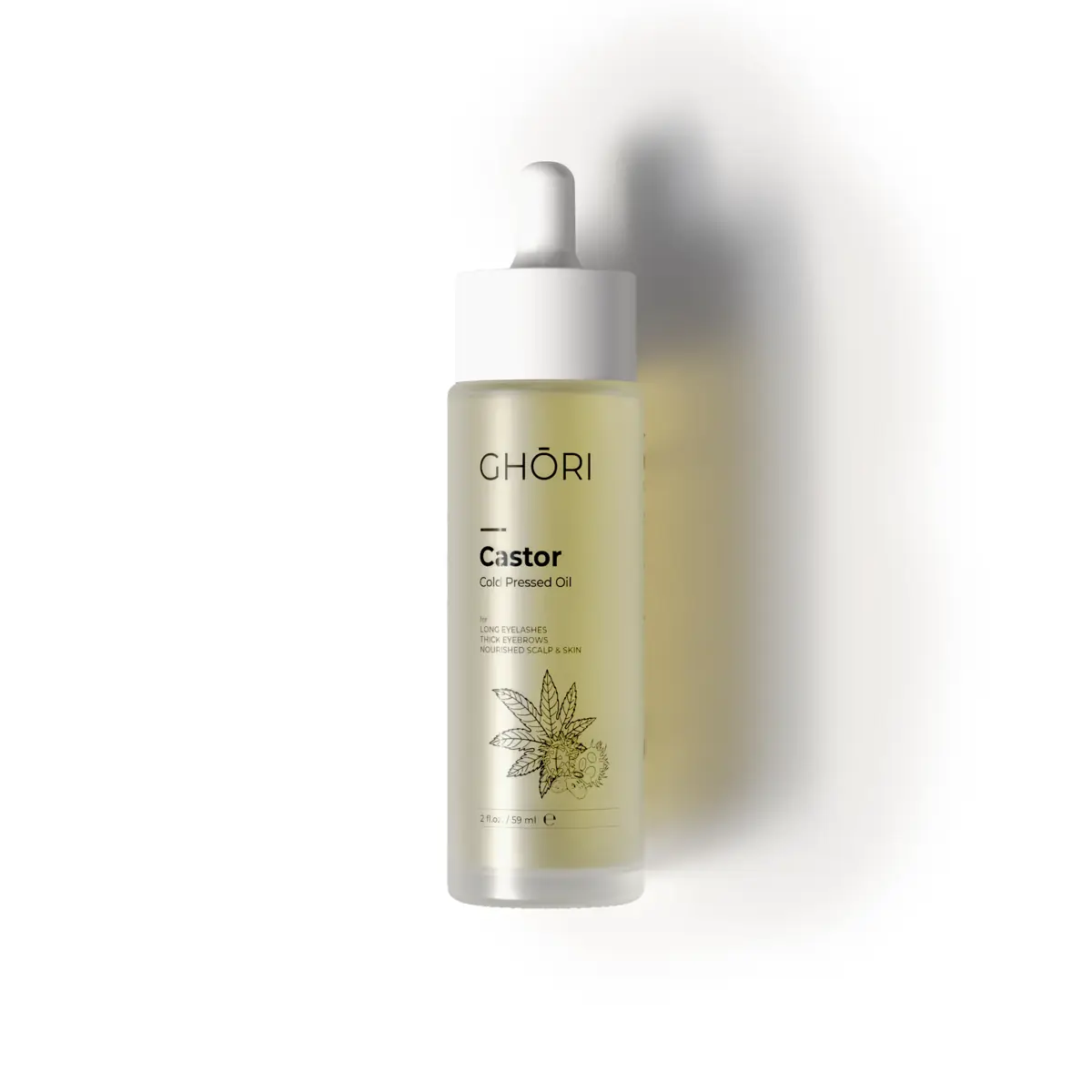
Cold-Pressed Castor Oil
Ricinus communis
90% ricinoleic acid — the omega that pushes the dermal papilla.
Region
Gujarat, India
Form
First-press vegetable oil
Shelf
24 months, cool storage
Class
Botanical oil
Key finding
90%
Ricinoleic acid content — the highest of any known oil
The brief.
Origin
Cultivated across the black-cotton soils of Gujarat and Rajasthan, the world's leading castor-producing regions (India supplies ~85% of global demand).
Extraction
First-press, hexane-free. Beans are hulled, cleaned, and cold-pressed under 40°C to preserve ricinoleic acid and vitamin E. The residual meal is composted, never solvent-extracted.
Sustainability
Castor plants are drought-hardy and grow on marginal soils where food crops fail. Our source cooperative pays growers a 12% premium above spot-market for verified pesticide-free harvest.
How it works.
The 90% ricinoleic acid in cold-pressed castor oil binds to prostaglandin receptors on the dermal papilla, prolonging the hair's anagen phase. Its unusually high viscosity forms a semi-occlusive film that traps moisture inside the cuticle — which is why hair feels dramatically softer after one application.
Delivers
- 01Thickens the strand shaft and darkens the appearance of thinning brows/lashes
- 02Seals in moisture, sealing split ends between salon visits
- 03Anti-fungal properties help calm flake-prone scalps
- 04Traditional remedy backed by centuries of Ayurvedic use
Molecular signature.
The bio-active constituents that make Cold-Pressed Castor Oil work — with standardised percentages where measured by HPLC.
- 0185–92%
Ricinoleic Acid (C18:1 ω-9)
Hydroxylated fatty acid — binds prostaglandin receptors on the dermal papilla to prolong anagen.
- 023–5%
Oleic Acid
Cuticle-smoothing omega-9.
- 034–6%
Linoleic Acid
Barrier-supporting essential fatty acid.
- 04
Vitamin E (tocopherols)
Natural antioxidant that stabilises the oil in-bottle.
Signal profile.
Six-axis assay
A living profile — the vectors that make Cold-Pressed Castor Oil.
- Evidence74
2 peer-reviewed sources
- Potency85
Standardised at 90%
- Safety62
Requires patch test
- Heritage80
Documented across 3 traditions
- Sensory88
Botanical oil profile
- Sourcing92
Traceable provenance
Heritage.
The record
Castor was buried with Egyptian nobility for cosmetic use in the afterlife — Ebers Papyrus (1550 BCE) documents its use as a scalp remedy. It appears in Sushruta Samhita (600 BCE) as an Ayurvedic hair oil, and Caribbean 'Jamaican Black Castor Oil' (roasted-bean variant) became the 20th-century global hair-growth staple.
Traditional use
Anointing oil in Ayurveda; Egyptian brow and lash blackener; Caribbean protective-styling sealant; West African braid finisher.
Naturally found in
- Native to East Africa (Ethiopia and Kenya)
- Cultivated commercially in India, Brazil, and China
- Wild along riverbanks across the tropics
Field → phial.
Every gram of Cold-Pressed Castor Oil passes five gates before it enters a Ghori formula. No shortcuts, no re-labels — the paper trail runs from soil to seal.
- 𖤣01
Stage 01
Harvest
Cultivated across the black-cotton soils of Gujarat and Rajasthan, the world's leading castor-producing regions (India supplies ~85% of global demand).
- ❋02
Stage 02
Extract
First-press, hexane-free. Beans are hulled, cleaned, and cold-pressed under 40°C to preserve ricinoleic acid and vitamin E. The residual meal is composted, never solvent-extracted.
- ◇03
Stage 03
Assay
HPLC-verified. 90% standardised for ricinoleic acid content — the highest of any known oil.
- ◉04
Stage 04
Formulate
Use neat, or diluted 30–50% into lighter oils for finer hair. On lashes/brows, one drop per side.
- ⌘05
Stage 05
Deliver
Stable 24 months, cool storage. Sealed under nitrogen where required.
Best for. Pairs with.
Best for
- ◆Sparse brows, lashes, and hairline edges
- ◆Dry, coarse, or over-processed hair
- ◆Split ends and mid-lengths that snap
Pairs well with
People often ask.
Will castor oil really grow my eyebrows back?
It won't create new follicles, but it thickens and darkens the existing vellus hairs so brows look fuller within 6–8 weeks of nightly use.
How do I wash castor oil out?
Apply shampoo to dry hair first, emulsify with your fingers, then add water. Two washes are usually enough.
Cold-pressed vs Jamaican Black — which is better?
Cold-pressed is purer and less irritating; Jamaican Black is roasted (adding wood-ash alkalinity), which some find more penetrating but harsher. We chose cold-pressed for daily safety.
The paper trail.
- [01]McMullen R, et al. J Cosmet Sci. 2003 — Ricinoleic acid effects on hair conditioning.
- [02]Vieira C, et al. Mediators Inflamm. 2000 — Anti-inflammatory activity of ricinoleic acid.
More in Botanical oil
Continue the dossier.
- 🇲🇦Circulation active
Rosemary Leaf Oil
Rosmarinus officinalis
The clinical rival to 2% minoxidil for pattern thinning.
- 🇮🇳Frizz control
Moringa Oleifera Oil
Moringa oleifera
72% oleic acid — the shine oil that shrugs off humidity.
- 🇺🇸Scalp revival
Peppermint Oil
Mentha × piperita
Menthol-driven cooling that outperformed minoxidil in murine trials.